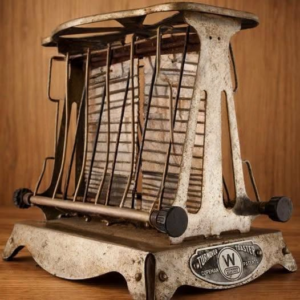
Nearly a century ago, before kitchens became sleek spaces of hidden heating elements and silent automation, breakfast looked—and felt—very different. On countless wooden tables sat a strange, almost skeletal device made of exposed metal coils, wire cages, and fragile hinges. To modern eyes it resembles something unfinished, like a prototype left out of its casing. But to families in the early age of electrification, this “mystery machine” was a daily companion: the turnover toaster.
It didn’t simply toast bread. It demanded attention, timing, and participation. And in doing so, it transformed a mundane morning routine into something closer to a shared ritual.
Unlike today’s pop-up toasters that quietly hide their inner workings, the turnover toaster placed everything on display. Two slices of bread were placed on a small rack suspended between glowing heating elements. As electricity flowed through the coils, they began to redden, slowly at first, then with an intensifying orange glow that felt almost alive. There was no timer, no automatic shutoff, no reassuring click to signal completion. The user had to watch carefully, judging the exact moment when one side had reached the perfect shade of brown before manually flipping the rack to toast the other.
It was part science, part instinct, and part luck.
For households in the early twentieth century, this was nothing short of revolutionary. Electricity itself was still a relatively new presence in many homes. The idea that heat could be generated cleanly, without flame or soot, felt almost magical. The turnover toaster represented that promise in its most tangible form. It was a bridge between two worlds: the smoky familiarity of coal stoves
Yet what made it remarkable wasn’t just its technology—it was its intimacy.
Breakfast, in those years, was not a passive experience. The toaster required presence. You couldn’t walk away and return later to a finished slice. You stood nearby, sometimes in your nightclothes, watching the coils pulse brighter as the bread slowly transformed. Families would gather around it, talking softly, waiting together. Children were often assigned the responsibility of “toaster duty,” a task that felt both important and slightly dangerous, as if they were being entrusted with a small piece of modern science.
And it wasn’t always forgiving. Bread burned easily. Timing was inconsistent. One distracted moment could turn a perfect golden slice into a charred mistake. But even those imperfections became part of the ritual. In a strange way, the unpredictability made the process feel more human.
As electrical engineering advanced, the turnover toaster gradually disappeared. By the mid-twentieth century, it was replaced by enclosed pop-up models with thermostats, timers, and insulated walls. These new appliances were faster, safer, and far more consistent. Bread no longer needed supervision. You could press a lever and walk away, returning moments later to a finished product.
It also reminds us that innovation doesn’t always begin with perfection. Sometimes it begins with something awkward, fragile, and slightly dangerous. Something that requires us to pay attention.
The turnover toaster may no longer belong in modern kitchens, but it remains a quiet witness to a time when progress entered the home not as a seamless experience, but as a shared moment of discovery. A time when breakfast wasn’t just eaten—it was observed, managed, and gently negotiated with a glowing coil of electricity.
And in that sense, it was never really just a toaster. It was one of the first small conversations between people and the machines that would eventually reshape their entire world.